

 DE
DE
ESD protection: basics, measures, tips
Electrostatic discharges (ESD) can be extremely dangerous for manufacturers of electronic assemblies with the smallest semiconductor components, as even the smallest discharges can damage or destroy sensitive electronic components. Electrostatic charges and, as a result, discharges occur when two materials with different electron work function come into contact and separate. Whether in the human body or in the production process - contact and separation occur in every workplace. Malfunctions of electronic components, financial losses and image damage are the result.
A comprehensive ESD protection concept for establishing an Electrostatic Protected Area (EPA) enables effective protection against ESD and the safe handling of ESD-sensitive components.
We will show you the optimum ESD protection concept and will be happy to advise you individually on the needs of your company!
Table of contents
What is meant by "ESD"?
ESD stands for "Electrostatic Discharge". Everyone is familiar with the phenomenon of sudden discharges between two objects from everyday life: a crackling jumper, hair sticking out, a small electric shock on the door handle, ...
ESD is caused by the prior separation of electrical charges. Two objects with different electron affinities come into contact and are separated again. A charge builds up which discharges suddenly when two objects with different electrical potentials approach or touch each other.
Do you want to know exactly how ESD is created and how it works? On our page "What is ESD?" you will find everything explained simply and clearly:
Why is ESD protection important?
We encounter electrostatic discharge on a daily basis: the "knock" you get on the car door, hair sticking out when you take off your hat or when there is a "spark" between two people.
What is a brief scare for us and usually just a nuisance is quickly a total loss for electronic assemblies that are fitted with small and tiny semiconductor components. Discharges with a potential of 10,000 volts are not uncommon, especially in dry air.
Avoiding ESD is therefore one of the top priorities for companies in the electronics industry.
In the worst-case scenario, a lot of damage caused by ESD is only discovered by the customer after some time and then leads to high repair or replacement costs. Much worse than the financial loss is the subsequent damage to the company's image if an entire product batch has been affected by a protracted fault.
The ESD protection concept: the basics
Protection against ESD in the electronics industry is a top priority. A comprehensive protection concept on several levels is essential and must be developed individually for each company.
| CURING
Protective circuits are integrated into all input and output paths to protect the sensitive components of devices from internal damage caused by discharges in the conductor network. These react to short-term discharges, ground them and thus protect the components behind them from damage.
| PREVENTION
Where no charges occur, no discharges can damage components. This is why employees' clothing, tools, equipment and floors in Electrostatic Protected Areas (EPA) are ESD-safe. Ionisers are also used to neutralise charges and humidifiers to reduce the tendency to charge.
| LABELLING
Knowledge transfer and warnings are essential when handling ESD-sensitive components. EPAs and components must be easily recognisable or completely blocked for non-ESD-protected visitors and suppliers. It is particularly important to sensitise employees to the topic. Training and further education are the be-all and end-all here.

ESD protection strategy: The sources of danger during the production run
| INCOMING MATERIALS, INTERMEDIATE STORAGE
Semiconductor components can be damaged by non-ESD-protected packaging, storage containers and adhesive tapes as well as by unprotected handling by employees. Therefore, every employee in the ESD area must be convinced of the necessity and effectiveness of ESD protection measures and this must be ensured through annual training.
| WORKSTATION, MACHINE
It is essential to ensure that all equipment is capable of preventing the build-up of electrostatic charges and dissipating charges in a defined manner. All equipment, workstations and machines must be checked regularly and this must be documented.
| STORAGE AT THE WORKPLACE
ESD-sensitive components can be damaged by the influence of unsuitable packaging and materials.
Therefore, these components may only be handled and processed at ESD-protected workstations. It must be ensured that no electrostatic fields are present at the workplace.
| DELIVERY AND PACKAGING
When packaging, always ensure that an ESD notice is clearly visible. Care must also be taken to ensure that ESDS outside an ESD protection zone are always stored and transported sealed in shielding packaging.
| TRANSPORT
During transport, care must be taken to ensure that ESD-suitable containers and transport trolleys are always used.
Even transparent sleeves for transport documents that are not made of ESD-safe material can cause damage. Intermediate storage on unsuitable materials should always be avoided.
ESD protection: Internal measures
On-chip protection structures are connected upstream and downstream to protect the tiny semiconductor elements from ESD damage and voltage peaks. Arrays of resistors, diodes, Zener diodes, transistors and varistors are used here. Unfortunately, there are limits to this protection mechanism, which is why these internal measures are only of limited use. The reasons for this are
- Influencing the input sensitivity
- Change in the frequency spectrum or access time
- Use of equally sensitive components that are only slightly faster or less sensitive to ESD pulses than the input structure
- The circuits require additional space on the chip surface
The smallest structures inside modern chip components can be as small as 14 nm. A nanometre is one millionth of a millimetre.

ESD protection: External measures
In order to create an area in which electrostatic charges cannot occur (Electrostatic Protected Area - EPA), many points around the workplace must be fulfilled. From the right flooring system, markings and access barriers to work clothing and the actual workplace, numerous standards must be met.
| FLOORING: DISSIPATIVE ESD FLOORS
ESD floor coverings, e.g. dissipative ESD rubber flooring, are installed in production halls to ensure that any charges that occur are safely dissipated. These floors are dissipative and fulfil the required limit values from IEC 61340-5-1. Typical and good values are usually between 106 and 107Ω measured against EPA earth.
To ensure ESD protection, the use of a suitable ESD flooring system is absolutely essential. Conductive nora® flooring systems made of rubber offer this reliable protection - in several respects:
AVOIDANCE OF LOADING:
Voltages that do not arise when walking are the best protection against ESD (walking test for nora® ESD flooring: < 10 V).
DISCHARGE OF CHARGE:
The guaranteed electrostatic properties ensure permanent ESD protection for the production process. (resistance < 3.5 x 10⁷Ω in the human footwear-floor system test according to DIN EN IEC 61340-4-5).
PROTECTION OF PERSONS:
The minimum insulation in accordance with VDE 0100/600 also ensures personal protection. Homogeneous and volume-dissipating rubber floors safely and permanently dissipate voltages via the copper strips laid beneath them and are therefore the ideal basis for ESD-protected production.
CLEANING AND MAINTENANCE OF ESD FLOORS:
When cleaning and maintaining dissipative floors, maintaining ESD protection is the top priority. It must be ensured that the flooring system permanently guarantees the required ESD protection without additional measures. The use of ESD waxes or emulsions is not recommended, as these run off quickly, form "runways" and impair cleanability.
Only use care products that do not build up layers so that the discharge values remain within the defined range. Conductive ESD rubber flooring systems can be cleaned and cared for during daily maintenance with pads designed for this purpose. This maintains ESD protection, saves money and resources and protects the environment.
| MARKINGS, SIGNS, STICKERS
Markings on the floor are used to mark storage areas for transport trolleys or specially ESD-protected areas. Equally important are signs and stickers to indicate potentially hazardous components and assemblies.
| THE WORKPLACE
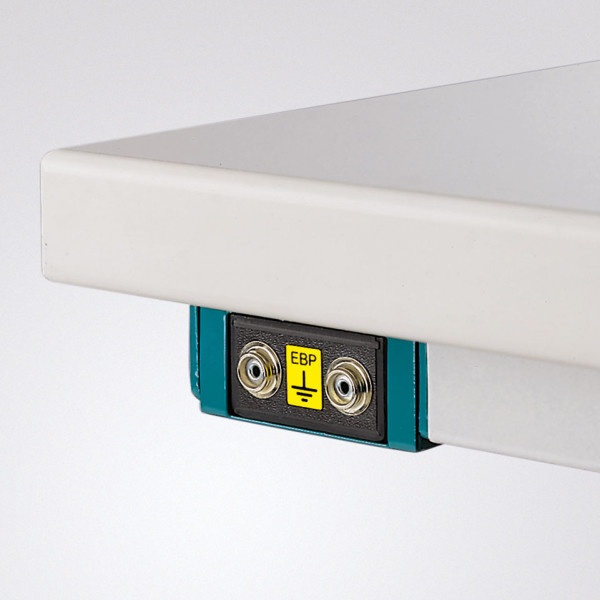
The perfect workstation should be ergonomically customisable and ESD-protected. The storage surface and an earthing cable dissipate electrostatic charges and keep the workstation charge-neutral.
Workplace design is a key factor in a company's success. In addition to comprehensive ESD protection measures, the creation of a positive working atmosphere is of great importance for satisfaction, efficiency and productivity in the company. We can optimise your ESD workstations with our products. Find out more and contact us for personalised advice!
| PERSONAL GROUNDING THROUGH ESD CLOTHING
People generally generate electrostatic charges when walking or sitting, but also through clothing friction. For this reason, various protective measures must be used to prevent charges and dissipate them in a targeted manner.
Shoes, coat and wrist strap with earthing cable are mandatory for employees in the production of electronics companies. The protective measures for personal earthing must be checked daily for effectiveness before entering the EPO.
| ACCESS CONTROL WITH ESD PERSONAL CHECK
Even the best safety guidelines are useless if they are not checked regularly. Protective measures for personal earthing, such as footwear or wrist earthing straps, must be checked daily before entering the EPO.
Visitors, supervisors and cleaning staff must also be equipped with suitable protective equipment to avoid hazards to semiconductor components and ensure ESD protection.
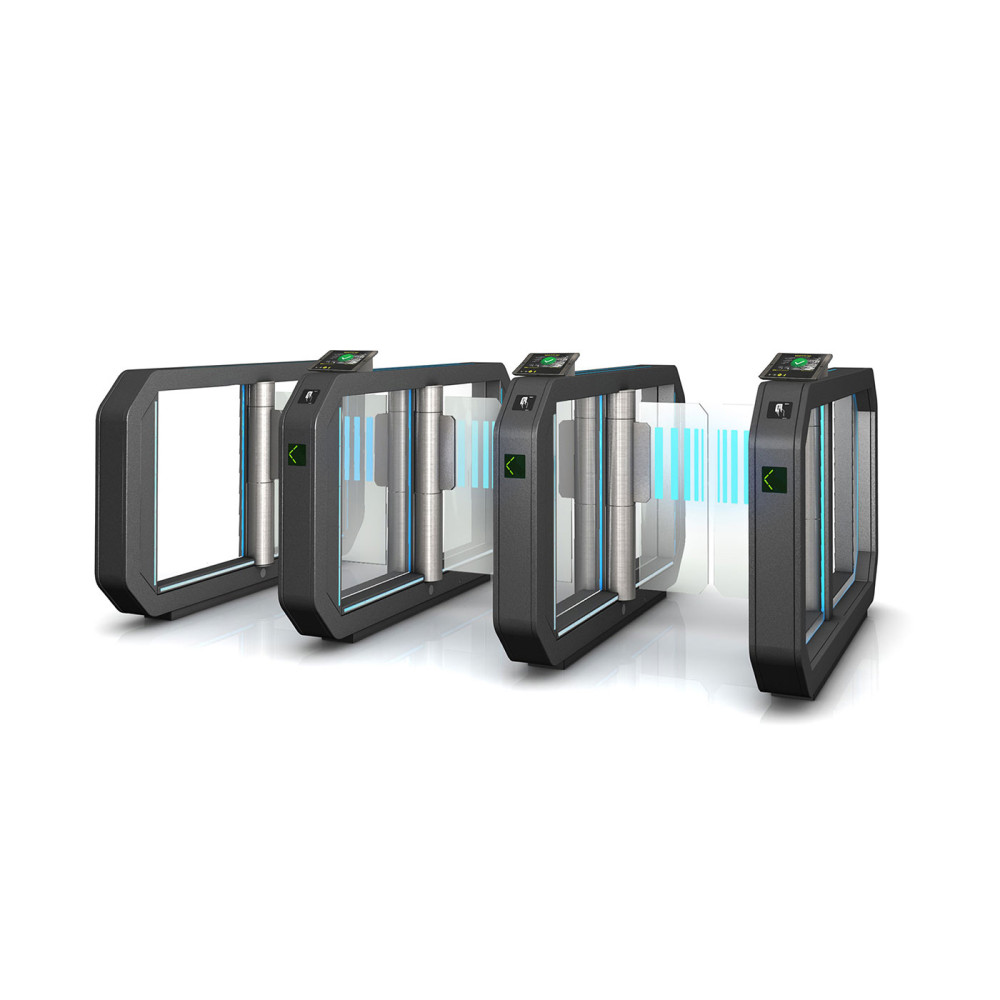
Access barriers at the entrances to EPAs are therefore a must. They measure the leakage resistance and only allow access once the test has been passed. This ensures that all persons entering the area are reliably earthed and that the main earthing measures in place are working.
In addition to the actual ESD protection, the manufacturer offers, for examplewanzl access control systems customised to the customer. These are equipped with additional security-relevant functions such as panic protection, which releases access in an emergency by means of a counter-pressure specified by the TÜV without the need for testing.
To prevent unauthorised persons from using this option to gain access to the EPA unnoticed, this passageway is protected by acoustic and visual alarm signals.
It can also be connected to the building's fire alarm system. In an emergency, the access barriers open the passageway automatically, thus ensuring a barrier-free escape route for staff.
| CORRECT STORAGE AND TRANSPORT
It is particularly important to ensure the safety of components and assemblies during transport from an EPA, for example from production to dispatch. Care must therefore be taken to ensure that the sensitive assemblies are transported in closed containers and only handled within ESD protection zones.
If the floor at the loading and unloading location is not conductive, care must be taken to ensure that all storage surfaces are ESD-suitable and that ESDS are only handled on these. In addition, the employee on site must be earthed via a wrist earthing strap. When transporting loose components, it is advisable to place them in conductive foam. This ensures that all connections have the same potential. ESDS must generally be stored outside an EPA in shielding packaging or containers.
Conductive packaging and storage surfaces must be used for storage and depositing within an EPA. The surface resistance of a storage surface must be between 104Ω and 109Ω and it must be suitably connected to earth potential. Furthermore, it is important that the components stored or being transported are labelled as being at risk of ESD. This can be achieved by means of clearly visible signs and stickers directly on the component. In addition, the storage location can be labelled as an ESD protection zone using floor markings.
| PACKAGING
Slowly dissipating foam underlays are often used in production in particular. When assemblies are transported from A to B within the company, particular attention must be paid to good outer packaging that has a dissipative or even shielding effect.
| PACKAGE
Whether for the transport or storage of components in the workplace - ESD containers protect vulnerable components and assemblies and are a must in the company. Unsuitable containers can generate strong charges and introduce them into an EPA, which affect ESDS through induction.
| HUMIDITY AND IONISATION
Especially in winter, when the humidity is low (below 15 per cent), we often feel the effects of electrostatic discharge, and usually very clearly:
The crackling when you take off your jacket and the way your jumper is pulled close to your body afterwards, or the occasional knock you get when you get into the car.
HUMIDITY
Humidity has a major influence on the discharge behaviour of materials. While the charging tendency of materials increases sharply in dry air, it decreases sharply in humid air. A fine film of moisture forms on the surface of the materials.
Therefore, no ESD measurement should be carried out at a humidity of more than 55 per cent, as this will lead to incorrect measurement results.
A constant humidity of between 40% and 60% can be a very effective additional ESD protection measure, but all process parameters must be taken into account when regulating it.
Various ionising systems are used in ESD areas:
Simple table-top models for partial use, overhead models for ionising entire workstations or ionising bars with optional compressed air supply.
IONISATION
If it is not possible or sensible to use dissipative material, charge reduction or discharge using an ioniser is an effective method.
Very often, assemblies are connected to highly chargeable housing parts during the assembly process. Ionisation is usually the only solution here. In this process, positive and negative ions are generated by means of high voltage through the corona effect. A stream of air
transports these to the charged component and neutralises the charge present there. It should be noted that the effect of ionisers decreases significantly with distance.
During installation, the discharge time of the ioniser should be checked using a charge plate set (accessory for electric field meters for testing air ionisation units) to ensure sufficient discharge time for the respective process.
It is also essential to check the ionisers regularly, as the high-voltage electrodes wear out and become dirty during operation, which greatly reduces their effectiveness.
Thanks to the targeted use of ionisers and the necessary ESD protection devices, there is no risk of damage when the component comes into contact with the circuit board.
MESSTECHNIK
In order to avoid unnoticed damage to sensitive semiconductor parts and components, regular checks and inspections in an EPA are necessary.
Otherwise, there is imminent danger, as the components concerned may still function after damage and may even pass a functional test, but then fail after a fraction of the actual life expectancy at the customer's premises.
Due to this high hazard potential of the components used, only materials whose properties exclude electrostatic hazards to the components must be used in production.
As the discharges and equalising currents that occur are usually imperceptible to humans, it is necessary to check the protective devices regularly using measurement technology.
Resistance measurements of the materials and equipment used are of fundamental importance here.
This starts when entering an EPA with access control and personal checks of the employee, extends to the regular measurement of the ESD floor and naturally also includes the surfaces and work equipment at the workstations.
This is the only way to ensure that no damage is caused by ESD during production.
At Keinath's training centre, course participants are taught how to use the various measuring devices and the correct test set-ups in accordance with standards.
ESD protection: clear behavioural guidelines are important
Optimum ESD protection with our products
Benefit from our more than 50 years of experience in the production of technical workstations. As Europe's leading specialist for ESD protection in the workplace, we are your partner in the development of customised and needs-based protection concepts against ESD in your company. Our products range from universally applicable workplace systems for production and assembly environments to systems for packaging, logistics and shipping.
Safe, durable and innovative - our MADE IN GERMANY products for your market advantage.