

 DE
DE
ESD: What is ESD? Electrostatic discharge explained simply
"ESD" stands for Electrostatic Discharge and is a phenomenon that everyone is familiar with: your jumper crackles when you take it off, your hair stands on end, there is a "spark" between two people, the car door gives you a small electric shock and much more. What is merely a nuisance in everyday life causes considerable damage in companies in the electrical industry. This is why such companies in particular should know everything about ESD and how to protect themselves against it - here you will find everything you need to know about electrostatic discharge explained simply and clearly!
Table of contents
How exactly does ESD occur?
Before electrostatic discharge - ESD - can occur, an electrostatic charge must have been generated. This is caused by the separation of electrical charges between two objects or materials.
Firstly, the two objects or materials come into contact. If these two objects have a different electron bond strength, electrons can flow from one material to the other. This is often provoked by friction. An electrostatic charge is created: the material that has released electrons becomes positively charged, the material that has received electrons becomes negatively charged. When the two materials are separated, there is a surplus of electrons on one side and a shortage of electrons on the other.
If the objects that come into contact with each other are made of highly conductive materials, there is a high probability that a charge equalisation will occur while the two objects are still separated. This is due to low resistance and good conductivity. As a result, the time constant for the charge exchange is smaller than the time required for the separation equalisation.
However, if the materials are poorly conductive or even insulating and other factors such as low humidity play a role, the conductivity of the materials is severely restricted and the time constant for charge equalisation is reduced. larger than the separation speed.
As a result, both objects retain their previously assumed charge states. If the last contact is interrupted and the two objects move away from each other, the potential difference increases. This is comparable to the way a capacitor works, in which the voltage also increases significantly due to the increase in the charge surface distance.
The size of the contact surface, the contact pressure and the friction intensity, material properties, the separation speed and the separation distance, as well as the air humidity are decisive factors influencing the charge strength and consequently the intensity of the ESD.
ESD: When do loads become dangerous?
Electrostatic charges occur constantly in everyday life. These charges are generally unproblematic. At most, it is a little unpleasant when your hair is charged or your jumper crackles.
Electrostatic charges can reach a contact voltage of up to several kV. Even this high voltage is generally completely harmless to humans, as the amount of energy transferred is very low and the current flow through the body is minimal.
The situation is different for electronic devices and components. Sensitive components can be severely damaged by even a small electrostatic discharge.
This results in high repair and replacement costs and often raises the question of when and where the damage occurred. For companies in the electrical industry, this means serious damage to their image if the damage has already occurred during production. Preventing ESD is therefore a top priority for the electrical industry.
Reduction in charge generation due to increased humidity
| Activity | Humidity 10% | Humidity >60% |
| Movement in the workplace | 6000 Volt | 100 Volt |
| Wrap paper in plastic wrapping | 7000 Volt | 600 Volt |
| Walking over plastic flooring | 12 000 Volt | 250 Volt |
| Remove bubble wrap | 26 000 Volt | 1000 Volt |
| Walking over carpet | 35 000 volts | 1500 Volt |

Discharge and vulnerable assemblies
Ever since semiconductor components triggered a technical revolution in electrical engineering in the 1960s, the problem of ESD protection has been omnipresent.
Components with conductor structures of less than 0.25 μm and reduced oxide thicknesses of well under 100 angstroms are becoming ever smaller and more powerful. However, this also makes them correspondingly vulnerable if an electrostatic discharge occurs.
The consequences are frequent:
- Thermal breakdown of a p/n junction
- Oxide breakdown (dielectric breakdown)
- Melting of the metallisation
This leads to malfunctions, shortened service life or ultimately to total failure of the semiconductor. In addition to people, devices such as soldering tips, production machines or packaging are also charge carriers.
To classify these more precisely, the standard refers to three models:
- HBM - Human Body Model
- CDM - Ccharged Device Model
- MM - Machine Model
Other models are described in the literature:
- SDM - Socket Device Model (model that simulates the discharge of an electrostatically charged component with associated base)
- CBM - Ccharged Board Model (Describes the discharge of an assembled module, through higher capacitances and inductances than in the Charged Device model)
- CSM - Ccharged Strip Model (In this model, the failures are simulated in matrix and strip form, for example in automatic placement machines)
- ESDFOS - ESD From Outside to Surface (Describes the direct discharge into the surface of the component structure; this occurs during the production of wafers and ICs)
Sensitivity of semiconductors
| Semiconductor type | Electrostatic voltage (V) / |
| V-MOS | 30 ... 1800 |
| MOSFET | 100 ... 200 |
| EPROM | 100 ... 500 |
| Junction-Fet | 140 ... 1600 |
| Operational amplifier (Fet) | 150 ... 500 |
| Operational amplifier (bipolar) | 190 ... 2500 |
| CMOS | 250 ... 2000 |
| Schottky diodes | 300 ... 2500 |
| Film resistor | 300 ... 3000 |
| Schottky-TTL | 300 ... 2500 |
| Transistor, bipolar | 380 ... 7000 |
| Thyristor | 680 ... 2500 |
Materials and surface resistances
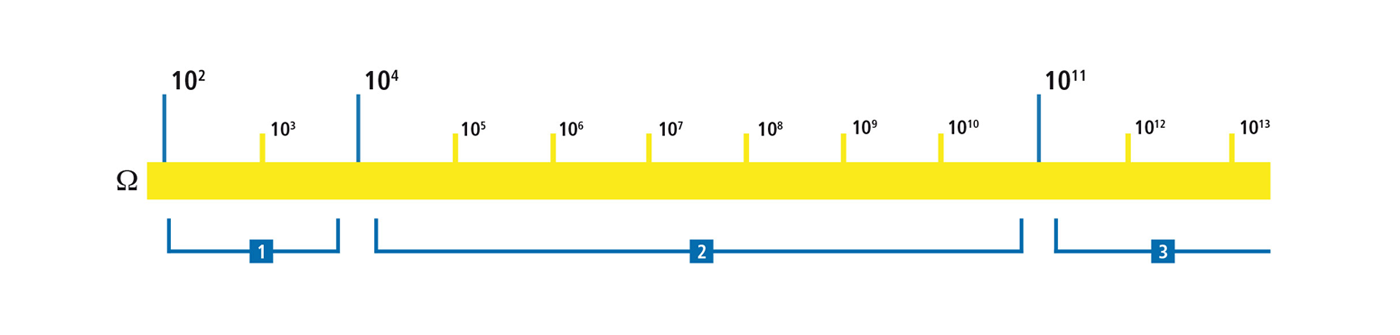
- 1| Materials thatConductive (conductive). They have a low resistance of 104 Ω and thus ensure that the charge flows away quickly. If such materials (metals, carbon and even the sweat layer of human skin) are earthed via a connection, the entire charge flows away. For materials < 104 Ω, however, the risk of hard discharge must be taken into account.
- 2| Materials thatdissipative (dissipative) dissipate charges over a longer period of time. Their surface resistance is between 104 and 1011 Ω. This prevents ESDS from discharging too quickly due to contact with conductive surfaces. They are mostly used as packaging materials in the electronics industry.
- 3| Materials with a surface resistance of more than 1011 Ω have an effect insulating. They cannot dissipate existing charges and are electrostatically chargeable. This is a particular problem in the electronics industry, as they form charge islands that pose a danger to unprotected assemblies and must be avoided. Insulators include air, glass and plastics.
- Materials thatshielding act like a Faraday cage. This means that assemblies encased in such a material are protected from the effects of electric fields. They are fitted with a conductive metal or carbon element that has a surface resistance of less than 10³ Ω.
How can you protect yourself from electrostatic discharge?
The establishment of an Electrostatic Protected Area (EPA), in which ESD-sensitive components can be handled safely, requires a comprehensive protection concept. The key points here are internal and external protection of the components and organisational protective measures that actively involve employees, visitors and suppliers.
You can find more detailed information and a fully developed ESD protection concept on our page on optimum ESD protection:
INTERNAL PROTECTIVE MEASURES
Integrated protective circuits on all input and output paths protect the sensitive components of devices from ESD events. Effective earthing strategies in the circuit design dissipate static charges.
EXTERNAL PROTECTIVE MEASURES
The Establishment of an ESD protection zone (EPA - Electrostatic Protected Area) serves to prevent electrostatic charges. Workstations, machines and conveyor belts must be able to prevent electrostatic charges. Conductive work surfaces, antistatic tools, ESD-compatible floors, work tables, workbenches and shelving are important components of an EPA and must be checked regularly.
One ESD-compliant protective equipment for employees includes work clothing with conductive fibres, safety shoes with conductive soles, wrist and arm earthing straps.
Packaging, storage and transport are areas in the production chain that must reliably protect sensitive components and finished products from ESD outside the ESD protection zone. ESD-compliant packaging, containers and adhesive tapes as well as underlays made of ESD-safe material shield the components and products from electrostatic fields.
ORGANISATIONAL AND PERSONAL PROTECTIVE MEASURES
Employees must be convinced of the need for ESD protection measures and adhere to them at all times. This requires targeted training and further education. Short-term employees, supervisors, visitors and cleaning staff must also be sensitised to the topic and must comply with the ESD protection measures.
ESD: Important terms and what they mean
Leakage resistance. The leakage resistance is the resistance between an electrode on the top of a device and the ESD earthing point. The earth leakage resistance is the resistance between an electrode on the top of a device and the earth potential.
Discharge time. The time interval in which a charged body is discharged from an initial value to a final value, e.g. from 1000 V to 100 V, through the connection to earth potential.
CDM. The Charged Device Model describes the mechanisms that occur when a charged component is discharged.
The electrostatic sensitivity is determined by a pulse defined via the equivalent circuit.
Conductive(conductive). These are materials that are either surface conductive, volume conductive or both. Their surface resistance or volume resistance must be less than 104 ohms (according to DIN EN 61340-5-3).
Dissipative(dissipative). These are materials that are either surface conductive, volume conductive or both. Their surface resistance or volume resistance must be ≥ 104 Ohm and < 1011 Ohm (according to DIN EN 61340-5-3).
EBP. Earth Bonding Point is the labelled connection for all ESD earthing measures; must not be used as a protective earth conductor.
EPO. The Electrostatic Protected Area is an area equipped with ESD protection measures in which ESDS can be manufactured, processed, packaged, transported or stored without the risk of electrostatic damage.
ESD. Electrostatic Discharge, is the electrostatic discharge as potential equalisation between charged bodies through direct contact or flashover.
ESD models. Idealised models are used in an attempt to simulate real ESD discharges and define test methods for determining component sensitivity. The most important models are HBM, CDM and MM.
ESDS. Electrostatic Discharge Sensitive Device. Designation for components or assemblies that can be damaged by electrostatic discharges during handling, processing or transport.
ESD voltage sensitivity. Damage limit of a component to certain discharge pulses of the discharge models HBM, CDM or MM.
Electrostatic charge. In physics, this is understood to mean static electrical charges that are created by mechanical contact and subsequent separation of materials.
HBM. The Human Body Model describes the mechanisms that occur when a charged human body is discharged via a component or assembly. A pulse defined via the equivalent circuit causes the electrostatic discharge of the human body.
Sensitivity determined.
Ionisation.Positive and negative ions generated by the corona effect under high voltage neutralise electrostatic charges. Mainly used for discharging non-conductors.
IsoIator. Materials are insulating if the surface resistance is greater than 1011 ohms.
Insulating. Are materials that are either surface insulating, volume insulating or both, whose surface insulation or volume insulation is ≥ 1011 Ohm.
Low charging. Materials are weakly chargeable if they have the property of not becoming charged or only becoming insignificantly charged on contact and subsequent separation or friction.
MM.The machine model describes the mechanisms that occur when a charged machine or system component discharges. The electrostatic sensitivity is determined using a pulse defined via the equivalent circuit.
Surface resistance. The surface resistance of a material is the electrical resistance between two electrodes placed on the surface. For comparative measurements, the distance between the electrodes must be specified.
Potential equalisation. Any electrostatic charges that arise must be equalised immediately against earth potential (0V) without risk of ESDS. The primary objective of ESD protection is to prevent the build-up of static charges.
Volume resistance. If a material is made entirely of conductive material, the current essentially flows through the body of the material. The resistance is measured between an electrode on the upper side and a counter electrode on the opposite side on the underside of the material.
Volume conductivity.Characterised by the fact that the entire material is dissipative, not just the surface.
Effective ESD prevention: with our top products!
As Europe's leading specialist for ESD-compatible workplace systems With over 50 years of experience in the production of technical workstations, we know how much influence workplace design has on the efficiency, safety and productivity of your company. We offer customised, industry-specific solutions for your factory equipment.