

 DE
DE

Flexible and connected: the Industry 4.0 workplace
What is Industry 4.0?
Industry 4.0 aims to integrate real and virtual processes. Intelligent information systems are what make this possible. In short, it is about connecting people, machines and data. In many sectors, such as mechanical engineering and logistics, Industry 4.0 is already the norm.
Rigid production lines quickly reach their limits in Industry 4.0. Demand fluctuates, products have shorter life cycles and production steps are constantly being optimised. Companies cannot afford time-consuming changeovers that take hours or even days.
Whether it’s material flow, capacity utilisation or machine bottlenecks – integrating real-time data allows disruptive factors to be identified immediately. However, the real benefit only becomes apparent when workstations and processes are flexible enough to respond swiftly to the insights gained from this data. That is why a workstation system that can keep pace is an advantage.
Industry 4.0 needs the right workplace
When it comes to Industry 4.0, it’s all about having the right setup. In production, you need modular workstations that can be adapted to new circumstances in no time at all. These include our BASIC, SINTRO, QUADRO and TriMax systems.
In production facilities where industrial robots – known as Automated Guided Vehicles (AGVs) – handle the supply of materials, a suitable infrastructure is essential. These autonomous vehicles require unrestricted access to storage systems and workbenches. Modular workstations make it straightforward to adapt the layout accordingly.
In some sectors, Industry 4.0 is shifting the focus of tasks from hands-on work to inspection. This calls for workstation systems designed for quality checks and repairs – for example, through optimally lit work surfaces. TriMax is one such system.
The workbench is therefore no longer just a surface, but an interface for manual work, material flow, IoT devices and data streams. Where assembly takes place today, quality checks may soon be carried out. A future-proof workstation system adapts to this change.
Not just a piece of furniture, but a system
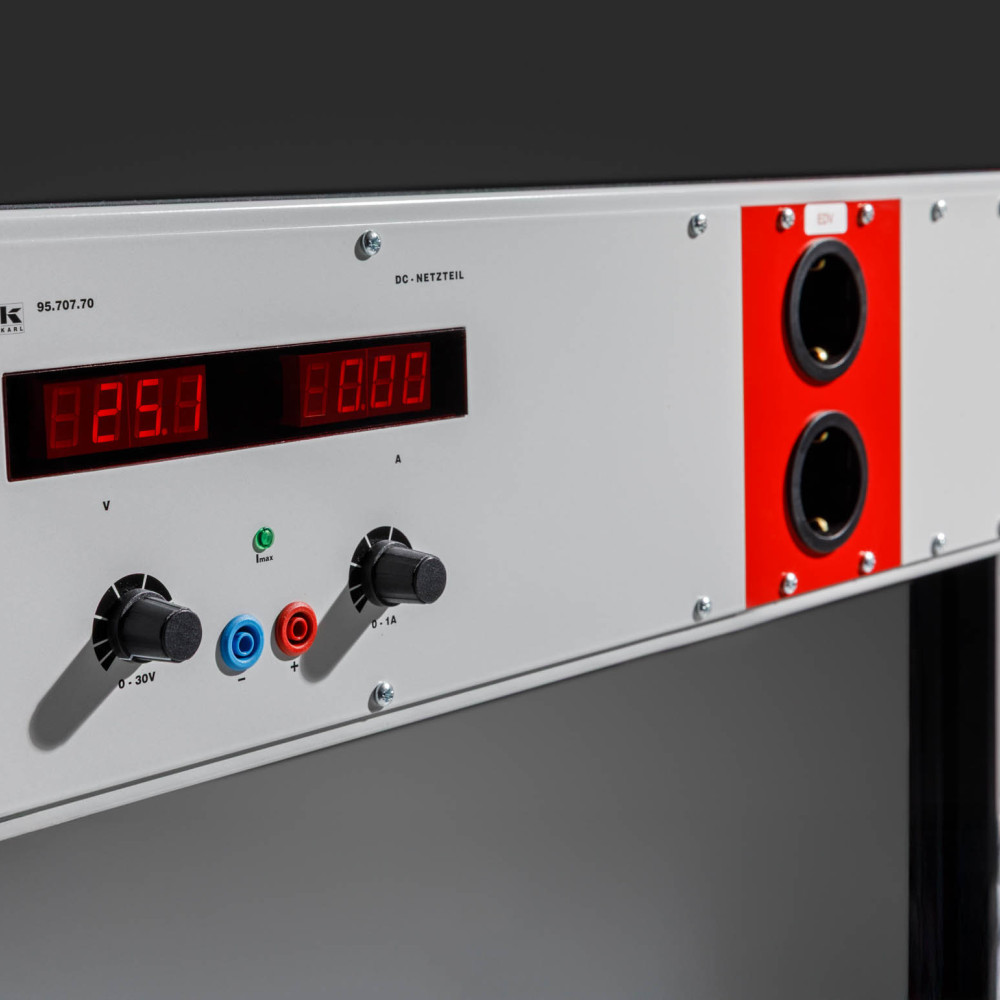
We view the desk not merely as a piece of furniture, but as a comprehensive system. The TriMax range, in particular, is equipped with data and communication interfaces. These include:
- RJ45
- CAT6
- SUB-D
- USB A/B
- USB-C
- Compressed air connections
- DC modules
Some of these modules are standardised, whilst others are interchangeable. This means you can arrange the latter as you wish – in whatever way best suits the product range. The required devices can therefore be connected directly at the workstation. Data transfer, for example via USB, is also possible via the workstation. This not only lays the foundation for effective working, but also for networked processes. And that is what Industry 4.0 is all about.
Make sure your workplaces are ready for Industry 4.0 – We’d be happy to help you with that!