
 DE
DE

How companies grow with modular workstations without driving up costs
Scaling up in production
The European defence industry is struggling to keep up with the rising demand for drones and ammunition – capacity is lacking, and production lines need to expand rapidly. Modular workstations such as the TriMax demonstrate how production can be scaled up without causing costs and effort to skyrocket.
Scaling vs. Growth: The Crucial Difference
Successfully scaling up production – what does that actually mean? Many people will now be thinking: ‘Scaling up – that’s growth’. But in reality, scaling up and growth are not one and the same.
Whilst both processes aim to increase turnover and market presence, costs rise in proportion to the growth of the business. When scaling up, companies aim to increase turnover whilst keeping costs and resource consumption low.
To ensure that fixed costs and capital expenditure do not rise in line with demand, the key lies in standardised processes and automated workflows. Manufacturing processes must be designed in such a way that they can be easily adapted to increased demand – without driving up costs or resource consumption.
What does ‘scaling’ mean in production?
Workflows can only be optimised if they can be analysed. This is the only way to eliminate bottlenecks and standardise processes. To operate efficiently (and cost-effectively), processes should be designed in such a way that every employee can carry them out in the same, effective manner. This ensures that the error rate remains consistently low, even as production volumes increase.
A workplace of this kind is not created simply by providing illustrated instructions for the various work steps. It is created when the flow of materials and reach ranges have been optimised, interfaces for the digitalisation of production are in place, manual processes are automated and quality controls are implemented.
Challenges of scaling
Increased production whilst keeping costs the same – at first glance, that sounds appealing to any business owner. However, not every business model is scalable. The higher the fixed costs, the more difficult it is to scale up production. The Federal Ministry for Economic Affairs and Energy describes financing as a key challenge in any scaling project.
On top of staff costs, which are already on the rise, there are often new production facilities or expanded storage space to contend with. If significantly more resources are required to cope with rising demand, this is more a case of growth than scalability.
When production is ramped up, more raw materials are also required. To scale up successfully, the suppliers and logistics companies involved must be able to grow accordingly. To avoid disruptions, it is worth diversifying the supplier network.
Scaling in practice: the European defence industry
To scale up successfully, new production lines must be set up within a short timeframe, capacity expanded and the ability to switch rapidly between different assemblies ensured – as the European defence industry is currently demonstrating. Many manufacturers are still finding it difficult to cope with the rising demand for drones and ammunition. The European Commission is therefore currently examining how to bridge capacity gaps in production and thus meet the demand from member states.
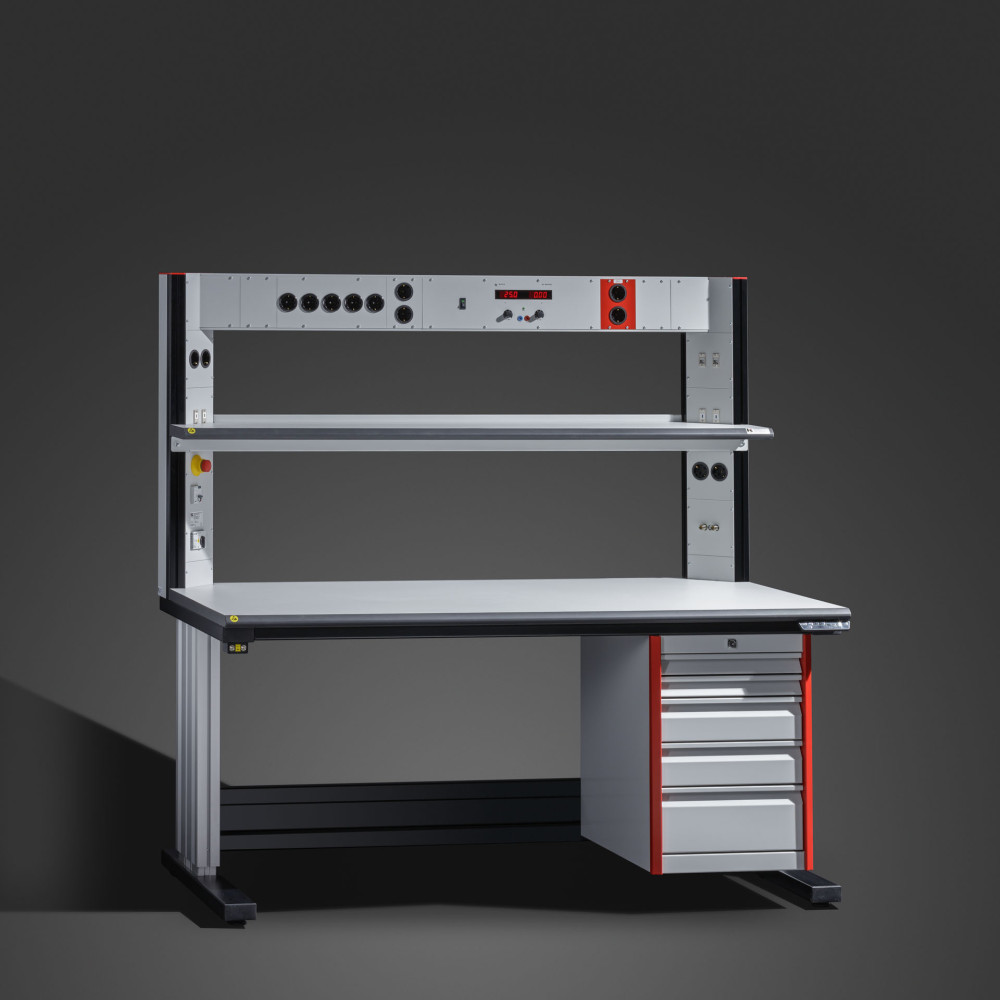
Workstations in the defence industry should be designed to lay the foundations for smooth, scalable production. In addition to basic features such as ergonomics and ESD safety, a modular system is required. This allows the equipment to be selected and arranged exactly as required.
If there are any changes to the production line, the workstation should be able to be adapted to the new processes in just a few simple steps and without the need for tools. One such workstation system is, for example, our TriMax, which, thanks to its ESD protection, is already in use in electronics manufacturing for the defence sector. It is easy to reconfigure and can be adjusted to provide optimal ergonomics for multiple users.
Checklist for scalable production
Anyone wishing to increase turnover without a corresponding rise in costs and resource consumption must invest at an early stage in standardised processes, documented procedures and flexible workplaces. As the defence industry demonstrates, rising demand alone does not determine the success of a scaling project. Planning and the business model are often the decisive factors.
Modular workstations such as the TriMax provide a practical foundation for this. They can be easily adapted to new processes, enable standardised, ergonomic working practices even with a changing workforce, and offer numerous interfaces for the digitalisation of production – precisely the characteristics that define scalable, cost-effective manufacturing.
Checklist: Is your production scaling up?
- Documenting processes: The work steps are recorded and analysed
- Introducing standardisation: Each step in the process can be carried out in the same way, regardless of who is carrying it out
- Keeping fixed costs stable: New capacity does not require a proportional increase in investment
- Planning scalable workstations: modular, adaptable design with optimal material flow
- Building a scalable supplier network: A diverse line-up helps to prevent bottlenecks
Anyone who meets these criteria is ideally placed to scale successfully. Still looking for the right workplace? We’d be happy to advise you on TriMax and our other solutions.
Further articles
The Chameleon TriMax: A look at its versatility
Production processes are changing – and with them, the demands placed on the workplace. The Chamäleon TriMax is designed to keep pace with this change: it is flexible, ergonomic and…
Why ergonomics is important in electronics manufacturing
Precision work places particular demands on ergonomics. Find out what is important when it comes to ergonomic workstations in electronics manufacturing, what role ESD protection plays, and how these two…

Industrial shelving systems: A comparison of our shelving ranges
Large, small, steel, wood – we’ve got plenty of shelving to choose from. With so much choice, it can sometimes be hard to decide. In this article, we’ll give you…

ESD measurement in industry: What is tested and when
ESD protection zone, yet a discharge occurs? This suggests that there are shortcomings in the ESD protection. There can be many reasons for this: ranging from staff error to worn-away…