
 DE
DE

How the workplace system in the defence sector remains flexible
The defence industry is expected to deliver faster than ever before, yet no one knows how long demand will remain high. What is needed is a manufacturing process that can cope with peaks in demand without keeping materials and workstations idle during quiet periods. How modular workstation systems can help.
A secure supply in uncertain times
Europe’s defence sector must deliver faster than ever before. The industry is capable of scaling up in terms of volume – yet the upturn is being held back. The reason is the uncertainty surrounding order volumes. Germar Schröder of Deloitte sees the biggest hurdle not as a lack of expertise or capacity, but as uncertainty over future volumes, as he explains in an interview with the Austrian industry magazine. Added to this are unreliable supply chains, which make stable production difficult.
It is not always a question of mass production. Often, these are complex, bespoke products with specific customer requirements that are scarcely viable for suppliers from a commercial point of view, as Hensoldt spokesperson Lothar Belz is quoted as saying. Flexible workshop structures and a reliable flow of materials make it possible to produce these small quantities reliably, even when demand fluctuates.
Double uncertainty: fluctuating demand, disrupted supply chains
If demand for complex bespoke products is now on the rise, manufacturers must be able to meet this demand without having to reconfigure the production line for higher output volumes in the long term. This is because high demand can quickly fall again, and there are hardly any customers outside the defence industry for these specialised components. The key, therefore, lies in being able to cope with a sudden surge in demand without being left with surplus materials and unused workstations during quiet periods.
The just-in-time principle, which is widely used in industry, is reaching its limits in this context. As the German Economic Institute (IW) points out, it relies on supply chains not being constantly disrupted – and that is currently not a given. The IW notes that companies are therefore diversifying their suppliers and increasing their stock levels. Creating additional jobs to cope with peak periods would also be an obvious solution. However, both require space, and this is usually in short supply.
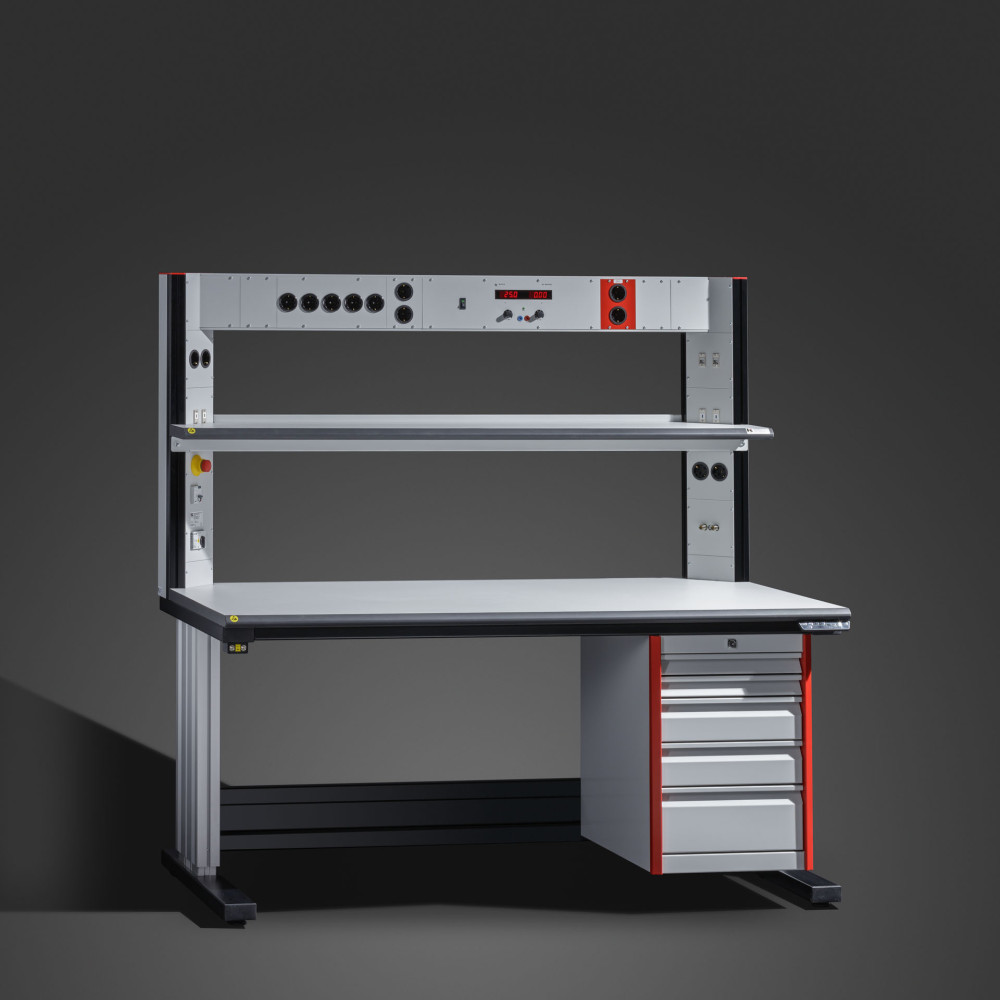
Refurbish rather than buy new: flexible workstations in the defence industry
Whereas production used to be carried out in an almost artisanal manner, small batches are now expected to be produced more quickly, and production must be able to switch rapidly to new products. Modular workstation systems make this possible: workstations for different tasks can be configured using standardised components. When a new order comes in, the workstations are reconfigured rather than new ones being purchased. In this way, manufacturers can respond to fluctuating production volumes without having to maintain additional workstations on a permanent basis. The workstation system provides a versatile basis for this TriMax by KARL.
The issue of space can also be addressed at the workstation. If components and tools are kept within easy reach at the workstation, space is used more efficiently and distances are reduced. If the production task changes, the way materials are organised is adjusted at the same time as the workstation is reconfigured.
Flexibility as the key to security of supply
For companies in the defence sector, it is becoming increasingly crucial to manage short-term peaks in demand without incurring high fixed costs in the long term. By coordinating the supply of materials, production processes and workplace design, companies can create the conditions necessary to produce economically and reliably, even in the face of uncertain market conditions.
Find out how TriMax keeps your production flexible, even when demand fluctuates.
Further articles
How the workplace system in the defence sector remains flexible
The defence industry is expected to deliver faster than ever before, yet no one knows how long demand will remain high. What is needed is a manufacturing process that can…

The dangers of electrostatic discharge (ESD)
A tiny spark with major consequences: electrostatic discharges can damage or completely destroy electronic components – sometimes without anyone even noticing. In this article, you’ll find out what risks ESD…

The Chameleon TriMax: A look at its versatility
Production processes are changing – and with them, the demands placed on the workplace. The Chamäleon TriMax is designed to keep pace with this change: it is flexible, ergonomic and…
Why ergonomics is important in electronics manufacturing
Precision work places particular demands on ergonomics. Find out what is important when it comes to ergonomic workstations in electronics manufacturing, what role ESD protection plays, and how these two…